
When the first point of impact is a car’s windshield, and the second is the occupants themselves, the results are devastating. Decapitation, brain trauma, Le Fort facial injuries, sometimes death by fire — in underride crashes, these consequences are the reality and frequently result in closed-casket funerals.
Decades of Regulatory Notice Without Action
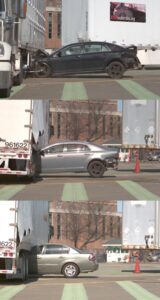
Underrides are caused by the physical mismatch between the height of the bottom edge of freight trailers and every other road user with which they share interstates and city streets. In underride crashes, passenger cars and light trucks slide underneath the trailer, permitting it to penetrate the passenger compartment and overwhelm every passive safety innovation from the last century, such as crumple zones, energy-absorbing bumpers, seat belts, shatterproof windshields, and air bags. Pedestrians, bicyclists and motorcyclists face death from crush injuries, when the unprotected sides of trailers allow their rear tandem wheels to run over those vulnerable road users.
The scale of this problem is not anecdotal. Thousands have suffered. According to a federal advisory committee report, “25,100 underride crashes and 31,500 corresponding fatalities from side underride, rear underride, and front override crashes, averaging 630 underride-caused fatalities per year” have occurred in the 58 years since actress Jayne Mansfield died in an underride crash in 1967.
NHTSA and Congress have long been aware of underrides. NHTSA’s founding administrator, Dr. William Haddon, testified to Congress in 1977, after he had become the president of the Insurance Institute for Highway Safety (IIHS), “Blood has been shed, heads literally have rolled and countless thousands of Americans have been injured because these agencies did not act. Further inaction would be inexcusable.” In the same hearing, he disparaged existing federal standards, saying, “The 25-year-old federal ‘rear end protection’ standard for devices on the backs of tractor-trailers and trucks is a sham.”
But in the intervening half century, federal regulators and Congress have done little to prevent underrides on America’s roadways. In 1996, NHTSA issued FMVSS 223/224, which required certain trailers to be equipped with a rear underride guard that could be protective in crashes with the center of the guard at closing speeds of up to 30 mph. Single-unit trucks were exempted from this standard. They remain to this day subject to a 1953 standard, even though they account for nearly one-third of fatalities from rear-end collisions with large commercial trucks and that “fatal crashes for straight trucks were reasonably similar to those of tractor combinations.”
In 2021, Congress required NHTSA to update the rear-guard standard for semitrailers, and NHTSA obliged in 2022 by adopting a 2004 Canadian standard, with which 94% of existing trailers already complied. Congress left to regulatory discretion whether to require that rear guards prevent passenger compartment intrusion in 30% offset crash scenarios, and whether to require that trailers be outfitted with side impact guards. NHTSA opted to not do either one.
Assessing the evidence, the federal Advisory Committee on Underride Protection concluded in 2024, “The fact cannot be ignored that very little has changed regarding side underride guard advancements in the last 50 years and no substantial progress has been made by DOT to prevent these horrific crash fatalities and injuries.”
A Century of Available Technology and the Industry’s Response to It
 The trucking industry has been aware of the dangers of underride since the early 20th century. The first patent for a side underride guard was awarded in 1915. Since that time, many manufacturers and inventors have received patents for rear and side underride guards.
That knowledge did not translate into the adoption of side underride guards. The industry has opposed underride safety mandates and, to a great degree, stymied voluntary deployment of underride innovations. In 1970, the trucking industry influenced USDOT not to finalize a rule that would have required commercial trucks to be equipped with rear impact guards capable of withstanding 50,000 lb. test force along all points of the guard, from the center to the outer edge. According to a news article from that time, “Abandonment of the proposal was a victory for organized truckers and manufacturers of heavy trucks and trailers. They had vigorously opposed it on grounds that the cost would be unjustifiably high and that it would prove to be an excessive economic burden on the industry. They had also challenged its value in saving lives and reducing injuries.”
Industry opposition to underride safety improvements has continued. Since at least 2004, trailer manufacturers have participated in a joint defense agreement. Trade associations, such as the American Trucking Associations and the Truck Trailer Manufacturers Association, have opposed underride guard mandates and even edited federal-sponsored research prior to publication to remove a recommendation for regulations.
How Independent Advocates Filled the Regulatory Gap
Into the breach left by industry-influenced government inaction, private safety advocates and researchers have made significant strides. IIHS developed the “TOUGHGUARD” standard for rear impact guards in 2017, which is a voluntary standard for 30% offset protection at 35 mph. Nine North American manufacturers, including the eight largest, have chosen to comply, earning a coveted award from IIHS, and demonstrating that there is a market for public safety.
Citizens, too, have made a big difference. In 2013, Marianne Karth lost two teenage daughters in an underride crash with a semi-trailer. In 2016, she convened the first underride roundtable with stakeholders from industry, engineering, government, and safety advocacy. Karth invented citizen-run crash tests, to which she has recruited engineers from the industry to participate. In 2019, Karth’s crash test demonstrated to Congress that simple, inexpensive technology could prevent side underride fatalities.
She has organized subsequent crash tests showcasing newer and lighter technologies that are equally effective at saving lives. And her relentless pursuit of safety has led engineers to achieve fatality prevention at 40 mph, far in excess of current federal standards. The work that Karth and others have done led Congress to require NHTSA to update its rear-guard standards.
The Case for Manufacturer Liability: What Juries Have Already Decided
As a result of their dedication, many underrides are now preventable with the installation of physical guards, though the trailer industry continues to resist their adoption.
 That gap between available technology and industry adoption is where liability begins. Trial lawyers often overlook product liability claims against manufacturers. Our firm analyzes each case through that lens to determine if trailer manufacturers should be liable for preventable underride fatalities and injuries.
Juries take all this history, the devastating nature of the injuries, and the sheer preventability of it all, and often do the right thing. In 2019, a New Mexico jury ordered Utility Trailer Manufacturing Co. to pay nearly $19 million to the family of Riley Hein, a 16-year-old who died in a fire under a trailer that was not equipped with side underride guards. In 2024, a Missouri jury ordered Wabash National Corporation to pay hundreds of millions of dollars in damages for the deaths of two men in a rear underride crash. That case settled thereafter with a $30 million payment by the trailer manufacturer.
Preventing death by underride is technologically achievable and economically feasible for many crashes. Juries have learned this, and they are shouting to the rafters for manufacturers to listen.
If you have a client with an underride case and are evaluating whether manufacturer liability applies, we welcome the opportunity to review it with you. Please contact us to discuss further.