
Driverless trucks have started delivering Doritos, Frito-Lay Potato Chips, and Gatorade to retailers in several states. The trucks are highly automated Level 4 vehicles, meaning that algorithms, not humans, are in full control of the vehicle at all times within specified constraints, known as Operational Design Domains (ODD). No human is required to be present in the truck cab at those times. This represents a very significant step forward in the potential take-over by autonomous trucks of the commercial trucking industry.
The autonomous box trucks delivering PepsiCo products were developed by Gatik, a Silicon Valley firm that began developing driverless freight transportation in 2017. Today, Gatik has agreements with Walmart and Loblaw, providing transportation for local commercial deliveries in Arkansas, Texas, and Toronto, Canada. Gatik also announced it would partner with NVIDIA and Isuzu to manufacture autonomous box trucks in South Carolina, starting in 2027.
Other companies are developing interstate autonomous trucks and autonomous driver components for those trucks. Key players include: Kodiak AI, Inc., Bot Auto, Aurora Innovation, Navistar, Einride, and Plus AI. Another application of autonomous trucks is platooning, which has begun in Ohio, where Kratos Defense technology controls the speed and direction of multiple trucks to create a closely-spaced caravan. Several large companies, besides Walmart and PepsiCo, have begun integrating driverless trucks into their operations, including Atlas Energy in Texas and Tyson in Arkansas.
Understanding the Levels of Automation
The levels of automation were initially defined by SAE International in 2014 and have been subsequently revised. Driving features with which we are well acquainted, such as automatic emergency braking and lane departure warning systems, constitute Level 0, “No Automation.” Level 1, “Driver Assistance,” encompasses driving aids such as adaptive cruise control or steering, but not both. Level 2, known as “Partial Automation,” may incorporate adaptive cruise control and limited automated steering inputs, such as lane centering.
Through Level 2, the human is still driving. This changes at Level 3. “Conditional automated driving” incorporates fully automated braking, acceleration and steering under certain circumstances, while human control is available and may be necessary based on circumstances. Level 4 automation, known as “High Driving Automation,” is full automation under specific conditions, and human intervention is optional. Level 4 vehicles may not even have pedal and steering controls. At Level 5, the vehicle is fully automated under all driving conditions.
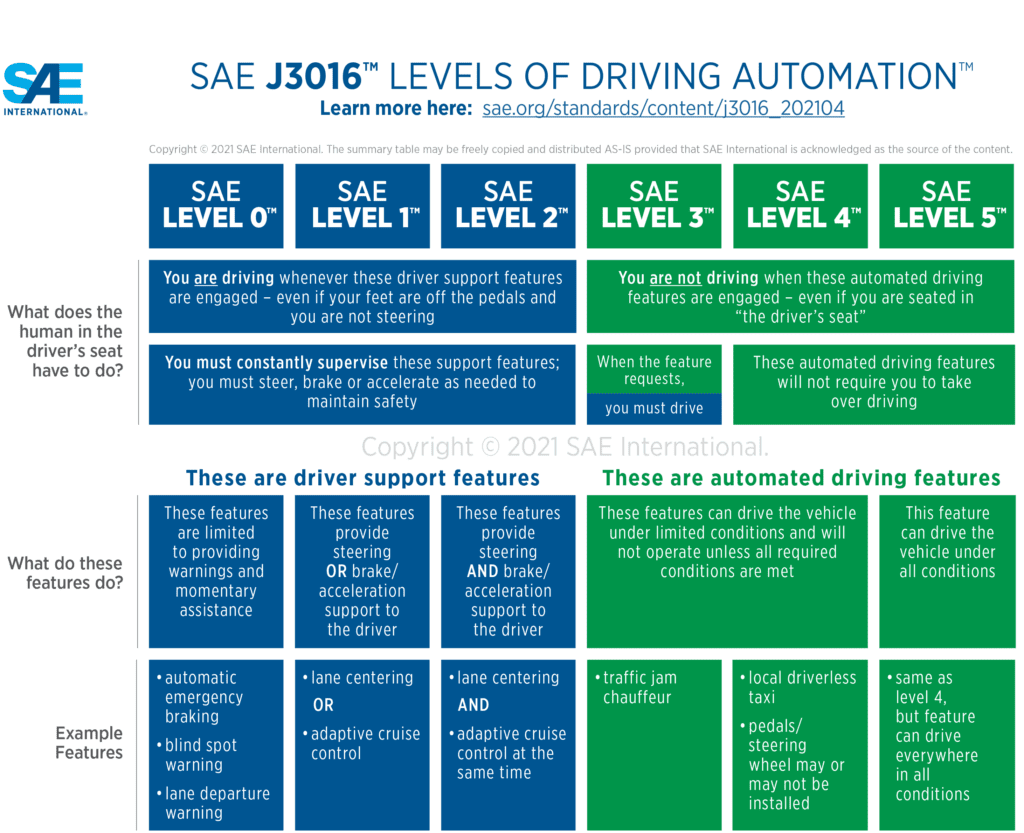
(Source: SAE International, May 2021)
The State of Regulation
Currently, state laws primarily govern autonomous truck deployment. Texas, Arizona, and Arkansas, where the industry is growing fastest, have lax rules that largely rely upon self-reporting by market participants. Gatik’s CEO, Arjun Narang, said about the current regulatory environment, “Regulations are not, I would say, a bottleneck for us at all.”
In April, California issued rules that are more extensive than other states’, covering subjects such as interaction with first responders, liability for moving violations, data reporting requirements, and testing criteria for permitting. Other states, like New York, will soon be issuing their own regulations.
Existing federal regulation partially governs trucks equipped with autonomous driving capabilities. FMCSRs today require all CMVs, including driverless trucks, to be equipped, loaded, and operated safely. Size and weight rules also apply. But many requirements presume that a human performs duties, such as roadside inspection or deployment of roadside warning signage, that an AI-driven automated truck cannot do. Other driver requirements, such as physical qualifications and Hours-of-Service rules, may not apply to a Level 4 autonomous truck’s operation within its ODD, but may apply to the human monitoring the truck, or the human who takes over driving responsibilities beyond the ODD.
More federal regulation is coming. In 2018, FMCSA issued an ANPRM requesting public comment on these and other questions. That rulemaking is ongoing. NHTSA also has broad authority over the manufacturers of autonomous trucks and the equipment in them. At the current time, neither the FMVSS nor FMCSR apply to the specific safety concerns posed by automated trucks and the artificial intelligence capabilities and equipment that drive them.
The Question of Safety
Proponents like to say that autonomous trucks represent a step forward in safety. For instance, Ohio State Highway Patrol Capt. Chris Kinn told Freightwaves, “Unlike human drivers, automated vehicles do not drive impaired, text while driving, fall asleep at the wheel or recklessly speed. The goal of this technology is to take the human error out of the safety equation.” Indeed, driver error is a major factor in whether a commercial motor vehicle is operated safely. Reducing driver error has the potential to improve safety.
But driverless trucks pose other questions for safety, liability for lapses, and the economics of safety equipment.
Who’s the driver? The duties and responsibilities for the safe operation of autonomous trucks shift from the human driver to someone else. Is it the motor carrier, or the developer of the artificial intelligence driving functions, and who bears the responsibility for updating driving software as it evolves and the liability for failures?
How is data recorded and retained? What replaces electronic logging devices and what are the specific parameters its replacement must record? What are the requirements for retaining the huge amounts of data processed by artificial intelligence driving systems that may be pertinent to crash reconstruction.
How do the relative costs and benefits of safety change with deployment of autonomous trucks? Autonomous trucks are much more expensive than conventional trucks, which implies that the relative incremental cost of safety equipment like side underride guards will decrease. Making SIGs even less costly will be automation’s utilization advantage, since automated trucks can operate for more hours, potentially around the clock, compared to human-driven commercial trucks.
How do other objections to safety equipment fare when autonomous trucking scales up? The industry opposes side underride guards, for instance, in part due to perceived operating concerns, such as the potential hazard posed by railroad crossings. But when artificial intelligence plans and executes driving routes, any validity of this objection may completely evaporate.
How does liability change with the introduction of autonomous trucks? With the removal of human drivers, defendants will face product liability standards, where the legal question is not, was the autonomous truck safer than a human-driven truck, but rather, was this autonomous truck the safest available design, and that question gets interesting when the artificial intelligence driving the truck is continually being updated.
Stay tuned. We will write more on these and related topics in upcoming posts.