Crash victims could walk away from many collisions with the sides of semitrailers, if only motor carriers demanded side underride guards and trailer manufacturers installed the technology that’s already available to them.
The 2026 Raleigh Crash Test
Last week, underride crash tests coincided with the 2026 Southeast CMV Safety Summit held in Raleigh, North Carolina. The demonstration of a side impact guard system was sponsored by AnnaLeah and Mary for Truck Safety and led by engineers from Impact Forensics, Seven Hills Engineering, Forensic Rock, and Hydro.
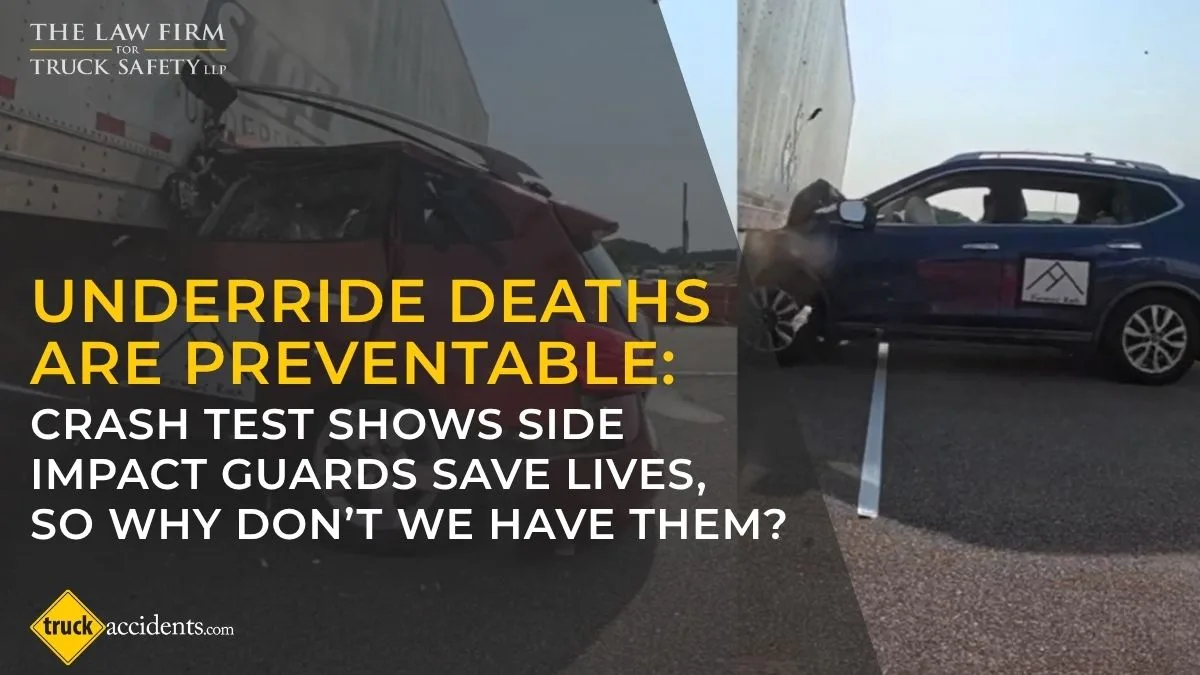
The test involved crashing Nissan Rogue compact utility vehicles into the sides of stationary dry van trailers at approximately 40 mph. One trailer was outfitted with an AngelWing-Safety Skirt hybrid system.
- AngelWing, invented by Perry Ponder more than a decade ago, has been available for sale from AirFlow Deflector, Inc.
- Safety Skirt, added by Aaron Kiefer, is a polyester webbing system that extends side underride protection along the full length of the trailer, all the way back to the rear guard.
The other trailer had no side guard, like most trailers on the road today.
Why Underride Crashes are So Deadly
Dry van trailer decks stand about 36-42 inches off the ground. In the most common configuration, that leaves a 20-foot-long gap running from the tandem wheels to the landing gear, with nothing to stop a vehicle from sliding underneath. In underride crashes, these facts create a lethal hazard.
Automobile bumpers, by contrast, rise to about 18 inches off the ground. When a car hits the side of an unguarded trailer, the bumper and crumple zone – the parts of the car designed to absorb impact – never make contact. Instead, the car’s A pillar and roof take the full force, often shearing the roof off entirely and striking the passenger compartment directly. As a result, heads “literally roll,” as Dr. William Haddon grimly put it.
The death toll from underrides is staggering. According to the federal Advisory Committee on Underride Protection, 8,950 fatalities have occurred in side underride crashes in the past 50 years. The U.S. Department of Transportation does not require side guards, and no trailer manufacturer currently equips its trailers with them as standard.
Pictures Worth a Thousand Words
Footage from this crash test demonstrates clearly the life-saving difference side guards can make:
As the video makes clear, the presence of a side impact guard can make the critical difference between a fatal crash and a fender-bender. Furthermore, the test proved that even at a closing speed of about 40 mph, underrides are preventable. That is a significant milestone, since it is much higher than the 35-mph impact speed the federal government currently requires in collisions occurring at certain points along the rear impact guard. Under current law, trailers are not required to have side underride protection.
Two members of Congress and the NHTSA administrator attended the demonstration. Every trailer manufacturer was invited to attend and test their own designs. Only Stoughton Trailers sent a senior official to observe.
No Excuse for Inaction
Many trailer manufacturers hold their own patents on side impact guard designs. According to AirFlow Deflectors, Inc., most have already tested the AngelWing system on their own trailers, but none have voluntarily implemented it. The market has had every opportunity and every incentive to fix the problem on its own. But it hasn’t.
NHTSA has had over 50 years to study the toll underrides take on road users. The agency collects data every year about underride fatalities. The NTSB and GAO have recommended that NHTSA address the underride problem. Congress did too and has provided NHTSA with all the legal authority it needs to mandate side underride protection. But like the industry it regulates, NHTSA – under Democratic and Republican administrations – hasn’t protected Americans from the lethal danger of side underride crashes.
The Bottom Line
Every year, hundreds of Americans suffer preventable decapitations, crush injuries, amputations, and closed-casket funerals because trailers aren’t required to have side underride protection. The continuing failure of NHTSA to mandate side impact guards compounds the industry’s choice to ignore this danger – and more importantly, this solution – for decades.
Engineers have demonstrated that side underride guards work. The remaining questions are not technical. When will trailer manufacturers and motor carriers care enough to invest in underride protection? When will NHTSA care enough to mandate side underride protection?